Arabic derives from Aramaic and other Assyrian languages such as: Babylonian, Akkadian and Sumerian.
With that being said,
The name “Muhammad” is spelled in Aramaic/Hebrew as מוחמד (MUḤMD) which is a transliteration of Arabic’s محمد
Now, while the name in Arabic means “the praised one” we can break the name down into Aramaic/Hebrew & Sumerian to get the ancient meaning of the name.
Mu- or -מו in Arabic & Sumerian indicates a negation or opposite meaning. In both languages it has multiple meanings but can be used to form opposites.
ḤMD or חמד is Aramaic/Hebrew meaning “desire”
Putting it all together we get “desire-less”.
Sources:
“mu-“ (Prefix)
https://academia.edu/resource/work/79019223
“desire” definition
https://cal.huc.edu/browseSKEYheaders.php
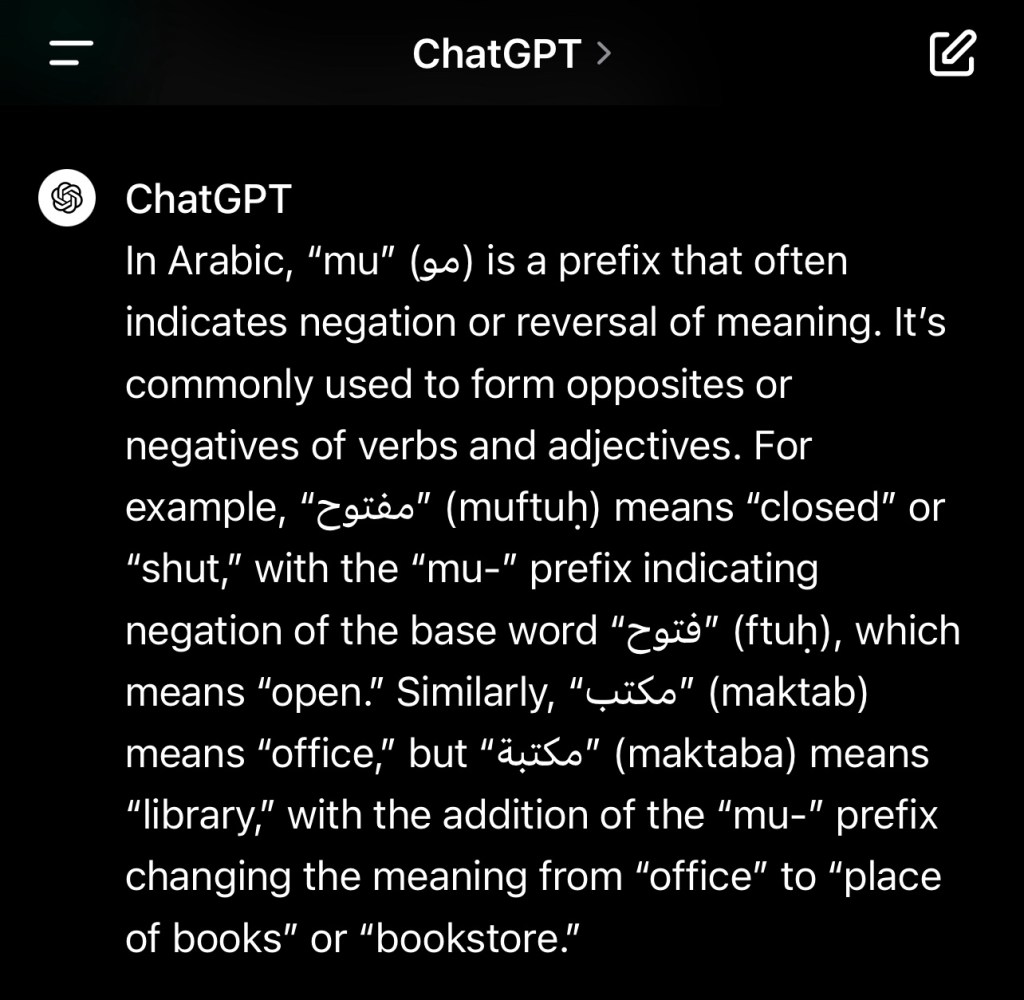
CHAT GPT 3.5 response for “mu-“:
In Arabic, “mu” (مو) is a prefix that often indicates negation or reversal of meaning. It’s commonly used to form opposites or negatives of verbs and adjectives. For example, “مفتوح” (muftuḥ) means “closed” or “shut,” with the “mu-” prefix indicating negation of the base word “فتوح” (ftuḥ), which means “open.” Similarly, “مكتب” (maktab) means “office,” but “مكتبة” (maktaba) means “library,” with the addition of the “mu-” prefix changing the meaning from “office” to “place of books” or “bookstore.”





Leave a Reply