
Arabic derives from Aramaic and other Assyrian languages such as: Babylonian, Akkadian and Sumerian.

With that being said,

The name β€œMuhammad” is spelled in Aramaic/Hebrew as ΧžΧ•Χ—ΧžΧ“β€‚(MUαΈ€MD) which is a transliteration of Arabic’s β€ŽΩ…Ψ­Ω…Ψ―

Now, while the name in Arabic means β€œthe praised one” we can break the name down into Aramaic/Hebrew & Sumerian to get the ancient meaning of the name.

Mu- or -ΧžΧ•β€‚in Arabic & Sumerian indicates a negation or opposite meaning. In both languages it has multiple meanings but can be used to form opposites.

αΈ€MD or Χ—ΧžΧ“β€‚is Aramaic/Hebrew meaning β€œdesire”

Putting it all together we get β€œdesire-less”.

Sources:

β€œmu-β€œ (Prefix)

https://academia.edu/resource/work/79019223

β€œdesire” definition

https://cal.huc.edu/browseSKEYheaders.php

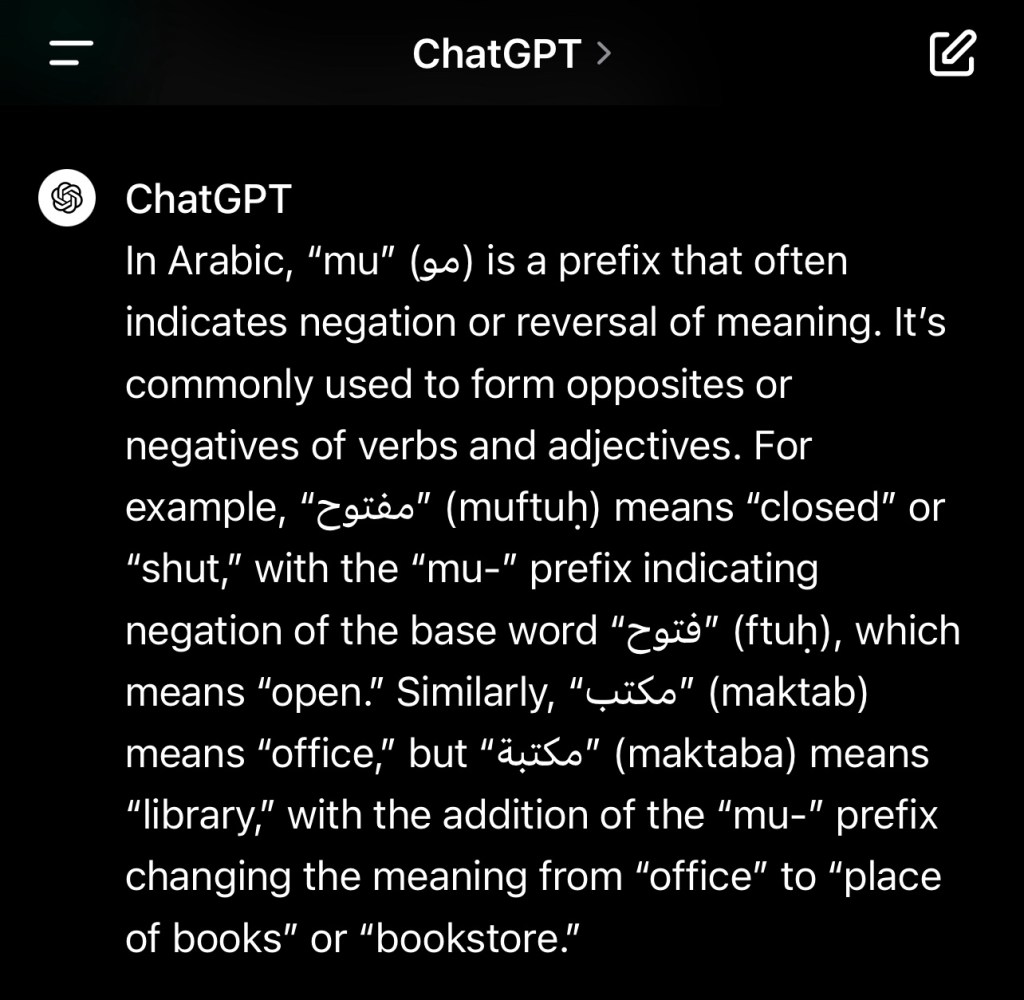
CHAT GPT 3.5 response for β€œmu-β€œ:

In Arabic, “mu” (Ω…Ωˆ) is a prefix that often indicates negation or reversal of meaning. It’s commonly used to form opposites or negatives of verbs and adjectives. For example, “مفΨͺوح” (muftuαΈ₯) means “closed” or “shut,” with the “mu-” prefix indicating negation of the base word “فΨͺوح” (ftuαΈ₯), which means “open.” Similarly, “Ω…ΩƒΨͺΨ¨” (maktab) means “office,” but “Ω…ΩƒΨͺΨ¨Ψ©” (maktaba) means “library,” with the addition of the “mu-” prefix changing the meaning from “office” to “place of books” or “bookstore.”
5 responses to “The Name β€œMuhammad” and its Origins”

  1. Tell me you don’t know anything about Arabic without telling me you don’t know anything about Arabic.

    Ω…ΩŽΩΩ’Ψͺُوح (maftΕ«h), not مُفΨͺُح (muftΕ«h) is quite literally the opposite of “closed” — it means “open.”

    The prefix mu- accompanied sometimes by an insertion of a letter within the word is equivalent to the English suffix -ed, that is to say, it describes something that is or has been ____ed.

    Also, the prefix ma- in Arabic is used for place named, such as madras (place to darasa “study”, i.e. a school), masjid (or a place to sajada “prostrate”, I.e. a mosque).

    May Allah guide you to spend your time on something better πŸ™

    Like

    1. Thank you for the comment, you’re missing the bigger picture here. I am providing information about what β€œMuhammad” would mean in languages more ancient than Arabic. In other words, Arabic doesn’t just come from itself, but it stems from parent languages. Shlema! π€”π€‹π€Œπ€€ APTTMH 𐀉𐀄𐀅𐀄

      Like

      1. Thanks for the reply. Unfortunately, the claim that the mu- prefix indicated negation in either Sumerian or Hebrew is false.

        A prefixed mu- in Sumerian instead is a conjugational prefix, with the phonetically similar but distinct nu- being used for negation. Source: https://www.jstor.org/stable/43074889

        The Hebrew prefix mΙ™- works pretty much the same as the Arabic mu-, i.e., it marks participles. Source: https://www.pealim.com/dict/1670-lefatzel/

        Like

      2. Furthermore, each language evolved via a distinct pathway from a common ancestor. One is not descended from the other. For example, Greek, Latin, English, Russian, Persian, and Sanskrit all come from the same Proto-Indo-European root. Likewise, the various Semitic languages like Arabic, Hebrew, Aramaic (which when the Assyrians conquered the land of Israel was incomprehensible to them, yet it stood alongside them), Amharic, and others are descended from an ancient proto-Semitic root. And English is not descended from modern German, but from an ancient language from which came German, English, and many others which is described as a Proto-Germanic language.

        Finally, Spanish, Italian, French, and the other Romance Languages are not descended from Classical Latin but rather from Vulgar Latin, the Latin actually spoken by people. It certainly borrows from Classical Latin, but its grammar does not directly descend from Classical Latin. Rather, the grammar descends from Vulgar Latin. Likewise, the grammar of each Semitic language mentioned here does not descend from the other, but rather from a common/mutual ancestor language.

        Like

      3. Hi, it looks like my first reply didn’t show up. Here’s what I said:

        — First, both Hebrew and Sumerian used the prefix mΙ™- and mu- respectively as part of normal verb conjugation. In Hebrew, to my understanding it had the same usage as Arabic, namely in marking participles. Also, the Sumerian verbal prefix for negation is nu- rather than mu-. Look up “sumerian verb grammar pdf” and hopefully you’ll find it.

        May Allah guide you to the straight path.

        Like

Leave a comment

Trending