
The most famous nickname for the God of the Israelites is 𐤉𐤄 , יה or “YAH”. But, what if I told you “YAH\YEH” is an abbreviation written in your translations of the Holy scriptures by Jewish scholars with the intentions of never being pronounced?
Spoiler: It’s just an abbreviated place holder and it doesn’t mean anything by definition. The origin of pronouncing יה was a magical incantation of TMH’s name.
Before I get into that, I want to state that YHWH (Hebrew) \ YHWY (Aramaic) isn’t an abbreviation, but it’s a short form of TMH’s longer name (see Exodus 3:14) that he told Moses to tell the sons of Israel. The abbreviated form of YHWH/YHWY is יה or 𐤉𐤄 (YH or “YAH”) and has 48 occurrences in the Hebrew bible (Tanakh) ranging from the books of Exodus to Isaiah see here. In the Aramaic Targums of the Holy scriptures the abbreviation occurs more frequently in several slightly different forms:
הי , ייי , יוי
YWY, YYY, HY
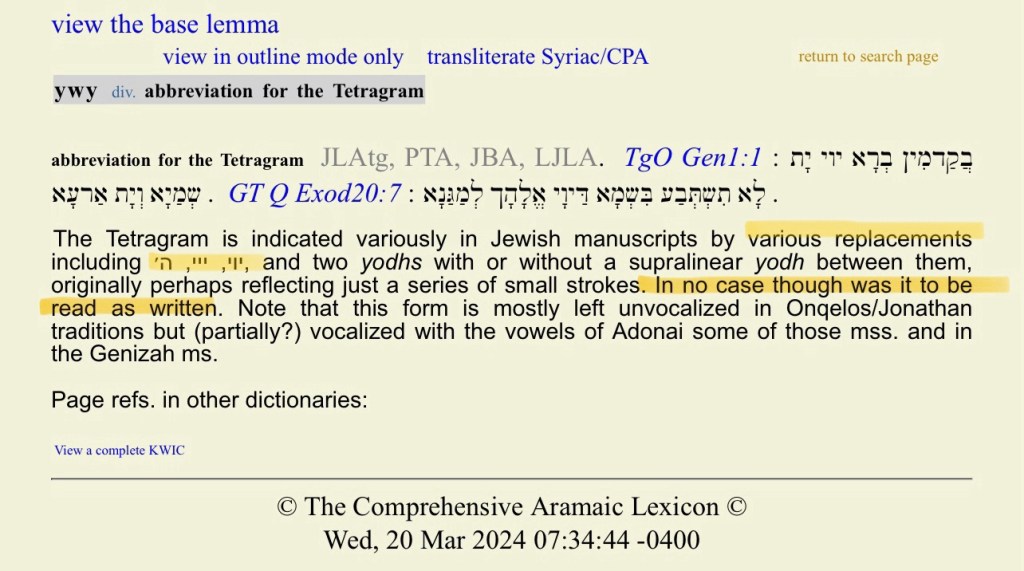
In the Aramaic Targum Psalms, one can observe that in almost all places where יה YH would be written in the Masoretic text or Hebrew bible (Tanakh), the word אלהא (ALHA) meaning “GOD” in the emphatic state or אילאה (AYLAeH) meaning “THE MOST HIGH” is used instead. In Psalms 94:12 of the Aramaic Targum Psalms the Hebrew יה or “YAH” appears, but the etymology of the abbreviation & pronunciation doesn’t trace back to Hebrew, it traces back to Syriac & Jewish Babylonian Aramaic as a magical invocation of the Tetragrammaton see here. Ever heard of the magical phrase “Abracadabra”? Well, this phrase is a mix of Hebrew & Aramaic used by ancient magicians. TMH’s LAW is hostile towards practices of pagan magic, divination, astrology, fortune-telling, psychic mediums, worship of other gods etc. see Exodus 9:11, Exodus 22:18, Deuteronomy 18:10, Ezekiel 12:24, Daniel 4:7, Micah 5:12.
What does YHWH/YHWY mean?
The Aramaic & Hebrew short form of TMH’s name (YHWY or YHWH) means “HE will be”, and it actually means something—like its longer counterpart (Exodus 3:14). Some will say “YAH/YEH” is just short for “YAHuah” / “YEHuah” but, it can only be so by adding vowels that are not written in the word by the usage of diacritic marks called dagesh/niqqud constructed by the Masoretes (7th-11th century CE). The sect introduced their dialect markings upon the original manuscripts that didn’t contain any. Therefore, the very first vowel is “Y” without any influences would be pronounced “ee” like in Spanish. In both Hebrew & Aramaic the prefix Y- or -י or -𐤉 is a 3rd personal pronoun imperfect placed before a verb meaning “he will”.
The second part of TMH’s name in Hebrew is הוה HWeH meaning “be/become” but, in Targum Aramaic it is the past tense form of הוי HWY meaning “was”. Hebrew also holds היה HYeH as another form of “be/become” and together with Biblical Aramaic holds הוא HUA for the same meaning. At times you will see Biblical Aramaic also hold הוא HUA and היה HYeH for “be” (Infinitive tense) and “was” (Perfect tense).
Please note that Targum Aramaic is a slightly different dialect than Biblical Aramaic.
In Ecclesiastes 11:3 we see that יהוא YHWA or YHUA is a form used meaning “it shall be”. If this not already confusing enough, Hebrew & Biblical Aramaic also holds הוא HUA as a stand alone option of the 3rd personal pronoun “he” (without “will”). In Targum Aramaic הוא HUA is only used as “he” and nothing else, unlike Hebrew & Biblical Aramaic. More than likely this is due to a possible origin in Akkadian: šuāšu meaning “to him”.
In Targum Aramaic “be/become” is הוי HWY/HUY which is used predominantly in different tenses. This Targum Aramaic form appears only 1 time in the Hebrew bible (Tanakh) in Isaiah 16:4 , which leaves me wondering…
🌑7/9/33☀️
⁃ 7th New Moon, 9th day, Year 33
⁃ 186th day of the year, from the 1st New Moon on day 0
⁃ 7th day of the week 𐤔𐤁𐤕𐤀 (SHIBITHA)



Leave a Reply