
While reading Exodus 20:2 in the Aramaic Targum of Pseudo-Jonathan (TPJ), I ran into what I thought was a phenomenon. I thought that 𐤃𐤄𐤅𐤅𐤍) דהוון) and בהון (𐤁𐤄𐤅𐤍) stems from the verb 𐤄𐤅𐤄) הוה) meaning “was”.
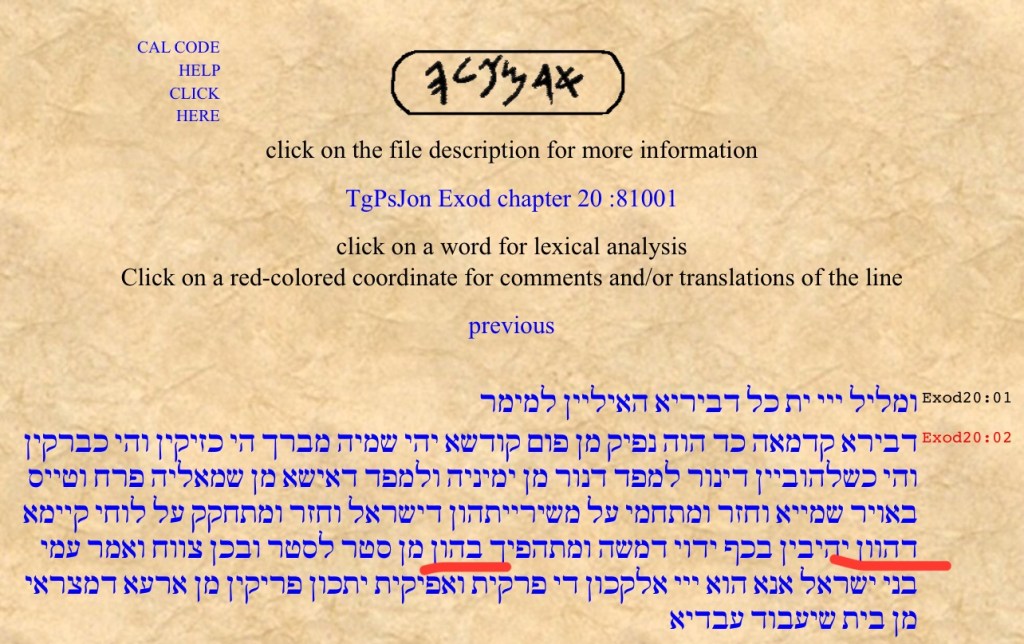
I wasn’t entirely wrong because, 𐤃𐤄𐤅𐤅𐤍) דהוון) means “that were” which is the plural form of “was”, with an addition of a demonstrative pronoun: “that” -𐤃-) ד)
Side note: 𐤄𐤅𐤅𐤍) הוון) and 𐤄𐤅𐤄) הוה) both stem from 𐤄𐤅𐤉) הוי) meaning “to be, is, exist”.
On the other hand, 𐤁𐤄𐤅𐤍) בהון) means: “in them”. Though, it may seem related to 𐤃𐤄𐤅𐤅𐤍) דהוון), it isn’t.
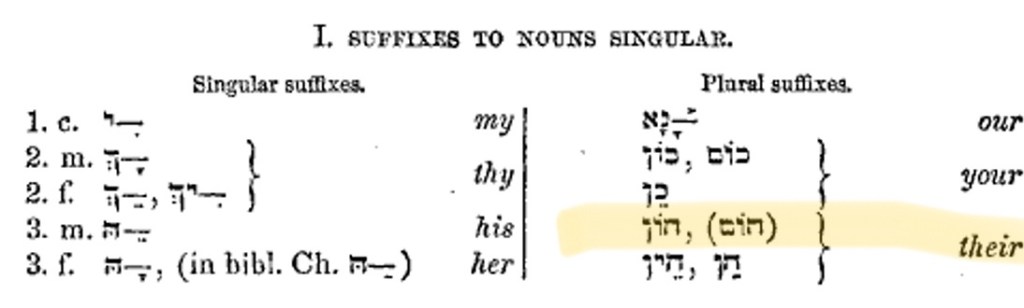
Again, this word has two sections. In the first section we have; -𐤁-) ב) is a common prefix-preposition attached to words meaning: “in, by, at, with”. In the second section, we can find 𐤄𐤅𐤍) הון) as a suffix meaning “their” (see above screenshot) but, in combination with -𐤁-) ב) it means “in them”.
🛸 10/293/2 🛸




Leave a Reply