
From all the knowledge I’ve researched about ancient America, I am a firm believer that North America contains the true holy land. So as you read this article, look through this lens.
The Sumerian, Akkadian, Babylonian, and Hebrew cultures contain two lunar calendars, one for observing holy festivals, and another for civil purposes. Both of these calendars contain 12-13 New Moons (months) depending on the fluctuation of the moon.
This is a link to an easy to see chart, displaying the civil calendars from all the cultures I previously mentioned: Babylonian calendar (see Civil calendar section).
Now here’s a link to the Hebrew festive calendar by itself: Hebrew festive calendar
Let’s observe two New Moons (months), Tishri and Nisan. According to both calendars in the links I’ve listed above, Tishri is traditionally held in the fall season, and Nisan in the springtime. Below, is a scripture telling us otherwise.
עוד כל יומי ארעא דרועא בתקופת תשרי וחצדא בתקופת ניסן וקורא בתקופת טבת וחומא בתקופת תמוז וקיטא וסתוא ויממי ולילי לא יתבטלון
Until all the days of the earth, sowing in the season of Tishri, and harvest in the season of Nisan, and coldness in the season of Tebeth, and warmth in the season of Tammuz, and summer and winter, and days and nights shall not fail.
Aramaic Targum Pseudo-Jonathan | Genesis 8:22
Now, I’m not a professional farmer or anything, but isn’t the best time to plant seeds for the majority of crops in the springtime?
ETYMOLOGY
Nisannu
This word can mean three things:
1) First produce of the season
2) Offering of first fruits
3) Babylonian month
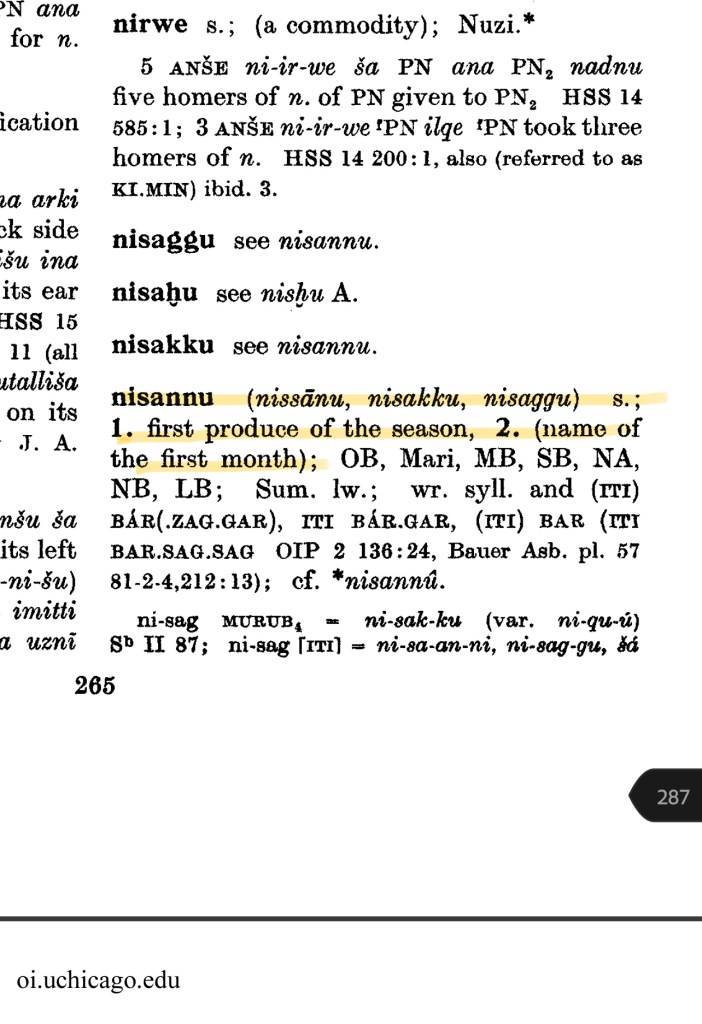
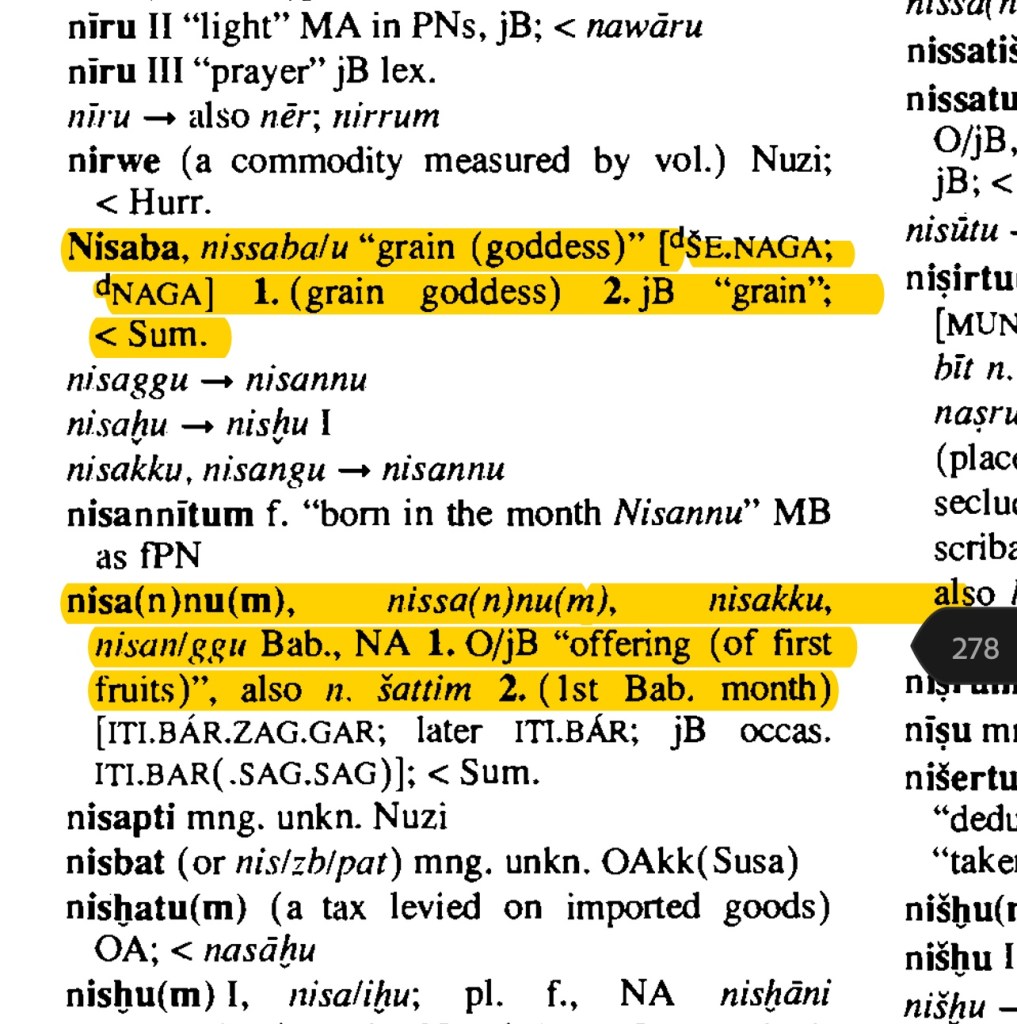
Nisaba is also associated with the word Nisannu, and has to do with “grain” or a “grain goddess”. Here in North America, grains and cereals are famous for being harvested around the fall season. The virgo constellation; also symbolized by a grain goddess, but instead named “virgo the virgin”, is in the fall season from late August to late September on the Gregorian calendar. If this isn’t enough proof that the Nisan ניסן or 𐤍𐤉𐤎𐤍 in the Aramaic scriptures is not a spring month, let’s look at some more scriptures.
וחגא דחצדא בכורי עובדך דתזרע בחקלא וחגא דכנשא במפקא דשתא במכנשך ית עובדך מן חקלא
And the feast of the harvest first-fruits of the work thou didst sow in the field; and the feast of gathering, at the end of the year, when thou hast gathered in thy work from the field.
Aramaic Targum Pseudo-Jonathan | Exodus 23:16
The “harvest” and “first fruits” fits the description of the fall season, especially when you add in the latter: “at the end of the year”.
Spring – Summer
Exodus 9:31-32 (Aramaic Targum Pseudo-Jonathan)
וכתנא וסרתא לקון ארום סרתא הוות בסירא וכיתנא עבד פוקלין
Literal translation: And the flax, and the barley were smitten because, the barley was too early and the flax made bud
וחייטיא וכונתיא לא לקון ארום לקישן הינין
Literal translation: and the wheat and the spelt not smitten because they’re late-seasoned
Months before the Passover which is in the New Moon or month of Nisan, TMH told Misheh 𐤌𐤔𐤄 (Moses) to send hail upon the land of Mtzrym (Egypt), as a punishment for declining permission to the Israelites to leave Mtzrym, and sacrifice their offerings to TMH. Observing the two verses above indicates two different seasons. The first verse indicates that the season is spring-summer, because flax is typically budding around that time, and barley is too young. The second verse confirms this, by telling us that two famous staple crops (wheat and spelt) harvested in the later fall season are not ready yet.
Fall season
Passover
ירחא הדין לכון למקבעיה ריש ירחייא ומניה תשרון לממני חגיא וזמניא ותקופתא קדמאי הוא לכון למנין ירחי שתא
Aramaic Targum Pseudo-Jonathan | Exodus 13:2
This month is ordained to be to you the beginning of the months; and from it you shall begin to number for festivals, and times, and cycles; it shall be to you the first of the number of the months of the year.
וייכלון ית בישרא בליליא הדין דחמיסר בניסן עד פלגותיה דליליא טוי נור ופטיר על תמכא ועולשין ייכלוניה
And you shall eat the flesh on that night, the fifteenth of Nisan, until the dividing of the night roasted with fire, without leaven, with horehound and lettuce shall you eat it.
Aramaic Targum Pseudo-Jonathan | Exodus 12:8
NISAN IS ABIB
יומא דין אתון נפקון פריקין בחמיסר בניסן הוא ירחא דאביבא
This day you are come out free; on the fifteenth of Nisan, which is the month of Abiba.
Aramaic Targum Pseudo-Jonathan | Exodus 13:4
Abib or Abiba holds 3 definitions according to the CAL (Comprehensive Aramaic Lexicon):
1) Ripe barley ear
2) Spring
3) Early ripening
Since we have sustainable information that Nisan or Nisannu is indeed in the fall time for the Israelites, then “Abib” used in the proper context of Exodus 13:4, should mean “early ripening”. To be fair, there is winter barley and spring barley. Winter barley is planted in the fall and harvested late spring, while spring barley planted in mid-march and harvested in late summer.
🌑7/5/33☀️
⁃ 7th New Moon, 5th day, Year 33
⁃ 182nd day of the year, from the 1st New Moon on day 0, and 3rd day since 𐤔𐤁𐤕𐤀 (SHIBITHA)




 MLK DUD 𐤌𐤋𐤊 𐤃𐤅𐤃

Leave a comment